

Alan Daniel Stiller
Retirement at 81 – A Legacy Cast in Concrete
This month, as Alan steps away at 81, we celebrate not just a retirement, but a legacy.
Our 50/50 partnership over these 27 years has been nothing short of remarkable. It wasn’t just a business partnership it was a shared vision built on trust, respect, resilience, and grit.
Alan always said:
“No job is too big and no job is too small.”
And he meant it.
Meeting Alan for the first time in 1999 started as nothing more than a job interview. Alan was running the business on his own at the time, as his late father, Maurice Stiller, was stepping into retirement. At the time Alan was merely looking for an employee with a background in concrete manufacturing but neither of us could have imagined what that moment would become.
From those early days, our intergenerational collaborative journey began almost immediately. I was eager to grow the business quickly, probably faster than Alan had expected. But it didn’t take long for us both to realise: there was no stopping us once we got going. That’s when we truly found our rhythm and started riding the wave together.
And what an incredible ride! Alan brought old-school knowledge passed down from his father, while I brought new ideas and kept pace with evolving technology. That balance became our strength.
Over the decades, Alan helped shape countless buildings alongside architects and designers across Johannesburg and beyond. He has a remarkable ability to take complex architectural visions and simplify them into workable, practical precast solutions. Where others saw complicated drawings and impossible deadlines, Alan saw opportunity.
If something looked impossible, he didn’t say no.
He designed.
He adjusted.
He made a plan.
And somehow, he made it work.
Looking back, it’s incredible to see how far we’ve come, from the days of floppy disks to a world where a cellphone holds more power than any computer we had back then.
Together Alan and I created a client centred company culture, a small residential coping carries the same importance as a large commercial façade. My partnership with Alan was never short of excitement. It demanded resilience, creativity, and grit. But above all, it was built on mutual respect and an unwavering commitment to delivering quality.
Alan, the “old goat,” as we joked, is deeply respected in the industry. Known to many as Mr Lintel, I doubt there’s anyone who has sold more lintels than him. There wasn’t a place he didn’t know or a customer he hadn’t built a relationship with. From north to south, east to west, and even beyond our borders, we grew and expanded together.
On a personal note, I remember trying to get to work earlier than Alan, only to realise very quickly, that no one could beat him. His dedication, his love for the business, and his commitment to his clients are what made him who he is.
Alan’s contribution to Modcon and to the many contractors, architects, and suppliers who worked alongside him cannot be overstated. He built more than structures; he built relationships.
He has copious stories. Favourite clients, difficult clients, big personalities and tight deadlines. But no matter who you are, you are treated the same, fairly, directly and professionally. This principle remains part of Modcon’s DNA today.
Alan, thank you for your leadership.
Thank you for your standards.
Thank you for the legacy you leave behind not only at Modcon, but across the industry.
From all of us, we wish you health, happiness, and time to enjoy the next chapter.
The buildings will stand for decades.
Your influence will last even longer.
____________________________________________________________________
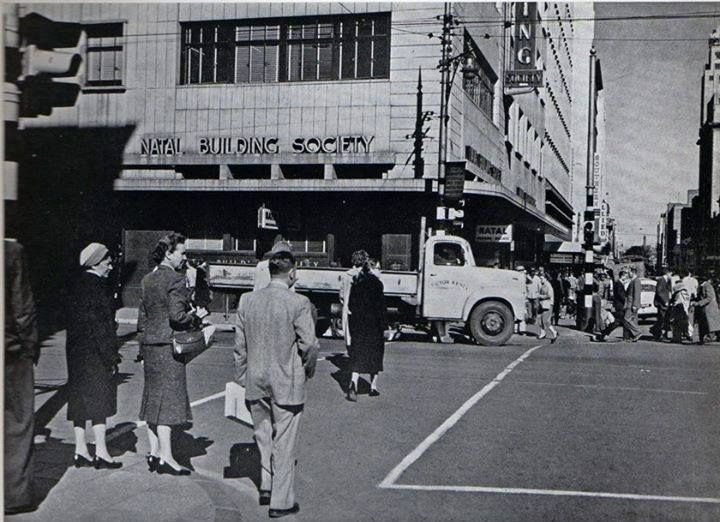
Delivering in Johannesburg in 1965
From Sand Roads to Suburbs: My Journey Before 80
By Alan Daniel Stiller
Dear friends,
My name is Alan Daniel Stiller, some folks know as Mr. Lintel. With my 80th birthday just around the corner, I wanted to share a piece of my life’s journey; a story of grit, growth, and good old-fashioned hard work in the precast concrete industry.
I was born in Harrismith on 28 September 1945. At 20 years old, I worked alongside my father in the family business, Modcon, earning just R35.00 per month. My job? Delivering precast products and sometimes even driving the delivery truck. I never considered myself a truck driver, but when duty called, I stepped up.
The Early Days on the Road
Back in the 1960s, delivering in Johannesburg and neighbouring provinces was a real adventure. Roads were often dirt or sand, especially around what are now bustling suburbs like, Halfway House, Bryanston and Southern suburbs.
Pretoria felt like you’d traveled to another province.
In those days, these areas were little more than patches of open land, with dusty roads and a few scattered homes. You couldn’t rely on road signs or a GPS to guide you, there were none! Directions from clients came before you left on the journey over the old landline telephone and were based entirely on landmarks.
I remember instructions like:
“When you get to the old four-way stop, drive 3 km and take the first left on the sand road. Look out for a windmill on your right. At the second gate, turn right, drive for 8 km, and the site is next to an old farmhouse”
Let’s not even mention if it had been raining how muddy the roads got and how high the chances of getting stuck were.If you missed a turn, you were almost guaranteed to get lost.
But we took pride in getting things right the first time no excuses. It taught us discipline, attention to detail, and above all, patience.
Building Modcon and a Legacy
Modcon started in 1955, when my father Morris began making terrazzo window sills. As the years went by, we expanded into lintels, wash troughs, water channels, and more. Now Modcon has over 15,000 different sizes and products in our catalogue.
Prices back then?
- Lintels: 17½ cents per meter
- Brickforce (3m roll): R0.25
- 50kg PPC cement: R1.25
- I have a petrol receipt from 1977 showing the price per litre was 25c.

As we grew, we faced transport challenges, especially moving goods over the province border. There were strict regulations. Our workaround? Load the truck in the afternoon, wait until 11 p.m, drive through the night to Welkom, offload at 4 a.m, and be back by sunrise ready for the next delivery.
That resourcefulness and drive is what has carried Modcon for nearly 70 years.
It’s hard to believe how much has changed, not just in prices, but in the world. Today, we have GPS, smooth highways, and smartphones. Back then, it was a map, a notebook, a landline, and a lot of guessing.
Here’s to the road behind us and the road ahead.
Warm regards,